Review: HTC Rezound

Every few months we see a new feature or hardware introduced on a phone that represents a new standard, a new criteria that future phones in the high end line must have or they will not succeed. If you look back through the years, you can build a list: the front-facing camera, the gigahertz processor, HD video capture, the WVGA display, the dual-core processor — all things that set a new standard for mobile phones. While not always important standards, these kinds of features force manufacturers to step up their game and move forward.

Today, the must-have feature is now the 720p display. Just last year a WVGA resolution was perfectly acceptable on a $200-plus smartphone!

HTC’s Rezound for Verizon is the very first of a wave of 720p phones to hit the market. As you might expect, its price ($299) and the long spec sheet are just as considerable as the display: 16GB of storage, 1GB of RAM, an 8-megapixel camera with 1080p capture, and naturally, 4G LTE. Also, the company is quick to point out that this is HTC’s first Beats Audio device to hit the US! So is this device worth all the hype? Find out for yourself in my review below.

Hardware & Design

  • Packing & Accessories

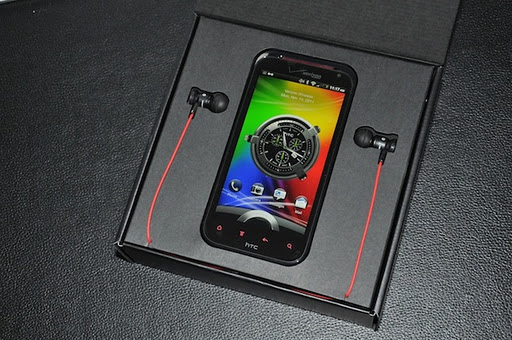
When holding the box, you have no idea what you are holding. Verizon’s smartphone marketing strategy is very fascinating, as the boxes for its Droid branded devices tend to have loud, in-your-face packaging with a glowing red eye featured somewhere on the box, the Rezound— which isn’t branded as a Droid device (for some unknown reason) — comes in a completely black box with nothing more than a subtle “HTC” logo at one end. That’s it. No Rezound logo, no picture of the phone. Very classy, very cool, and very understated.

When you remove the outer sleeve and flip open the box, you’ll find the Rezound placed between the included Beats By Dre earbuds, one bud on either side. This part of the packaging is all black as well, which really makes the red wires of the headset pop out at you. It’s very clear that HTC believes that its Beats By Dre partnership is a huge deal, and in the consumer audio business, those red wires have become very, very iconic. If you’ve read some of my other reviews, you’ll know that I’m generally not a fan of headsets included with phones, but the addition Beats Audio may be an exception. More on that a little later.

Removing the top layer of the box’s interior reveals the remainder of the accessories: some documentation, a small pleather pouch for your Beats headset, some replacement earbuds of different sizes, and HTC’s usual USB wall charger and Micro USB cable. There’s also a 16GB microSD card included, which brings the phone’s total to 32GB between the internal and external storage — an appropriate amount considering the Rezound’s music promotion, oh, and the fact that Verizon’s charging $299 for it on contract.

  • The Rezound

At 13.7mm, the Rezound isn’t going to win any records for slim, sleek design. What’s interesting is that it launched just a few days after Motorola’s 7.1mm Droid RAZR, which is by far the thinnest LTE smartphone (and probably the thinnest smartphone) on the market. They’re both $299, and Verizon is positioning them both as very high-end devices, but their designs really couldn’t be much more different.

At first glance, you might think that the HTC Rezound is a very thick, or chunky device, but, it feels quite good in the hand. In fact, I prefer it to the Droid RAZR, which doesn’t really have any “hand-friendly” areas or surfaces.  The Rezound’s 720p screen, is at 1280 x 720 compared to the RAZR’s 4.3 Super AMOLED qHD display. If you’re familiar with HTC’s Evo 3D, the Rezound’s look and feel are very similar, right down to the red accents. Around back you’ve got a textured, soft-touch material that should prevent all slips or drops.

Other features on back include the 8-megapixel camera with dual LED flash, the important Beats and 4G LTE logos, and a well-concealed loudspeaker grille. At maximum volume, the speakerphone was really loud for calls, music, and video playback.

The entire back lifts off to reveal a vibrant red interior. As with the more recent HTC devices, the cover doubles as an antenna, and if you took the cover off of the phone the Rezound immediately went to zero bars of reception as soon as I took it off. Obviously, you won’t be using the phone without a cover, but that raises the cost of getting a replacement and complicates the job of third-party accessory makers that want to offer an extended battery kit.

Finally, that takes us to the front of the Rezound. The bezel is fairly minimal on the left and right sides of the screen, with just a hint of black chrome peeking out from the very edge. The top has a long earpiece with a dark red grille, and I think it’s a nice touch. You can make out the front-facing camera on the upper right, but you won’t be able to see the proximity or light sensors at all. Below the display, the Rezound uses red backlighting for the four capacitive buttons; like the phone’s other red accents, I really like it, but I imagine some people might prefer the more traditional white.

All in all, I like the shape, size, and feel of this phone a lot more than I thought I would. It’s heavy, solid, and relatively thick, which makes it a complete opposite of the Droid RAZR’s insane design and engineering. I think some will find the phone too heavy or too thick, but hey — that’s exactly where the RAZR comes in (and now also, the Galaxy Nexus).

Display

I can talk about the Rezound’s LTE radio, 1.5GHz processor, and Beats Audio, but really, everyone’s eyes will be fixated on one feature alone: the 4.3-inch 720p LCD screen. It’s the first phone to launch with a high-definition display in the US, and a lot of people would want to see if the new display is better than the qHD screens on some of the more recent models from Motorola or HTC.

I can sum up all your questions about this display in one word: YES! You want this screen (or something very much like it) in your next smartphone. At a very high 342ppi, the Rezound shares the iPhone 4 and 4S’ unique ability to make individual pixels all but disappear to the naked eye, but, the Rezound does so at a higher resolution and a much larger screen size than the iPhone. Compared to the PenTile qHD displays in phones like the Droid Bionic and Droid RAZR, the Rezound runs circles around them, both for clarity and accuracy.

Outdoor viewability is very good, though I was able to get the screen to wash out in bright, direct sunlight (easily fixed by placing a hand over the screen). Looking at the Rezound full-on, I found contrast, brightness, and color temperature to be very near perfect. It’s very difficult to find fault with this display.

Beats Audio

I had to find out of the included earbuds are any good. I should point out that these are not the high-end Beats By Dre Tour model, but, they appear to be pitch-perfect copies of the company’s $100 iBeats. They fit in my ears very well, were comfortable to wear at length, and can be customized to fit your ears’ needs with the included pack of replacement buds.

The audio quality for earbuds is amazing! When you play music through the built-in Music app, a Beats logo appears in the status bar — this is your cue that the phone is running the Beats By Dre Mode, and it makes the output sound much “bigger and better.” All of my music sounded very good and, in all honesty, much better than I expected.

Cameras

I was really delighted with the Rezound’s camera interface, which is snappy, very pretty, and easy to use — it’s the same one that HTC employs on the Vivid and other recent devices, and it’s apparent that the company put some serious thought into how it should work. Autofocusing is fast, as is  the shutter speed, and I found that I could really get up close with macro shots — about an inch and a half. I was once again disappointed here with the lack of a two-stage (halfway down for focus; full click for camera shot) hardware shutter button, but it seems like this is a feature that manufacturers are trying really hard to move away from for some reason.

I wasn’t blown away by the quality of either the 1080p video or the 8-megapixel photos when blown up to full size — there appears to be quite a bit of compression noise. It’s okay for messaging use and perhaps a wallpaper, but I wouldn’t replace either your point-and-shoot or your HD camcorder with the Rezound.

The front-facing camera is actually quite good, producing stills far cleaner and clearer than they realistically need to be for the intended duty (video calling, primarily). Like the Vivid, it’ll also let you record 720p video up front.

Wrap-up

The Rezound will likely go down as one of the best Android phones ever to launch pre-Ice Cream Sandwich — it’s incredible display, coming loaded with the LTE modem and beefy processor, is simply too great to ignore. If you’re looking for a phone with HTC Sense UI, blazing fast Verizon 4G LTE, and an amazingly fast processor, look no further than the HTC Rezound.

Review: AT&T’s HTC Titan

The new HTC Titan is a big and beautiful piece of technology running on AT&T’s super-fast 4G network. The main question that’s raised by the new 4.7 inch Titan is, how big is too big?  Comparing it to the iPhone, the Titan is a whole 1.2 inches bigger than the iPhones 4S’s retina display screen.

The age of the extra-large smartphone may be already here, but that’s not the only new wave that the Titan is creating. Along with the new 3.7-inch Radar, the Titan is one of HTC’s first phones to ship with the new OS, Mango 7.5. Can it compete with the new iPhone 4S? Or how about the Galaxy Nexus? What about AT&T’s new 4G network? How does it stand up to Sprint’s or Verizon’s? Is the slightly improved internal hardware bump worth the upgrade over a Mango-updated first-generation Windows Phone 7 handset? All of these questions will be answered in the review!

Hardware / design

At 9.9mm (0.39 inches) thick, the Titan is a bit thicker than the iPhone 4S’ 9.3mm (0.37), but when you take the rest of its dimensions (131.5 x 70.7mm / 5.18 x 2.78 inches) into consideration, it actually looks and feels very sleek. Its large frame carries the 160-gram (5.6 ounces) weight well, with a perfect balance between the top and bottom of the device. Exactly as with the Android-powered Sensation 4G before it, the Titan’s sides and back are composed of one, easily removable, aluminum shell. It houses the phone’s antenna in a small plastic compartment and the outside of the Titan is fitted with a dedicated camera button, volume rocker, power / lock key, a 3.5mm headphone jack, and a Micro USB port. It is worth noting that the single-piece aluminum case feels extremely sturdy and rigid, while fit and finish between it and the Titan’s internal components are simply flawless.

For some, reaching the power button in single-hand operation is a chore. The Titan will fit inside your trouser or jacket pocket, though you’ll be constantly aware of its hefty presence. While not officially “awkward”, the ease of use falls short compared to phones in the 3.5- to 4.3-inch range.

The 4.7-inch Super-LCD inside the Titan is simultaneously it’s biggest strength and it’s greatest weakness. This phone’s great appeal (and the reason it makes an awesome first impression) is in the wonderful color reproduction and viewing angles it offers at such an outlandish size. You may have seen the same display technology already used in the likes of the Desire S, Incredible S, and even the HD7S, but until you witness it on the Titan’s scale and used by such a minimalist design, you can’t appreciate just how amazing it is. Blacks are deep, whites are true and uniformly lit across the screen, and colors lose very little of their vibrancy as you start to look at the phone from oblique angles. Watching videos and browsing and composing photos on the Titan’s display is truly a delight!

Where the Titan’s screen lets me down is in its most basic of specifications: resolution. I found WVGA (800 x 480) inadequate for the screen size when reviewing the 4.5-inch Galaxy S II Epic 4G Touch and now that I am looking at it on a 4.7-inch phone, it feels even more so. The Windows Phone tiles are so large that they appear cartoonish and everything else about the Titan’s UI has a similarly magnified appearance. Importantly, the pixel density isn’t so sparse as to let you recognize individual pixels, but Windows Phone already has a number of intentionally oversized UI elements whose additional enlargement on the Titan starts to look a bit comical. This detracts from the phone’s theme of efficiency, as the user is forced to scroll through huge chunks of blank space and excessively large text, whereas they might have expected that buying a larger device would grant them more comfortable viewing.

Battery life & Reception

The Titan runs Qualcomm’s MSM8255 Snapdragon system-on-chip at 1.5GHz. It’s been a very popular chip in Android phones this year, with Sony Ericsson’s 2011 Xperia line using it and HTC inserting it into the Incredible S and Desire S, among other devices. What’s become very clear over time is that this second-generation Snapdragon SoC represents a huge leap forward in terms of power efficiency. That’s very important when comparing the Titan against the first-generation Windows Phone devices as they ran on the first-generation Snapdragon. Due to the S2 chip’s power HTC’s felt confident enough to hitch operational speed up to 1.5GHz. The astonishing thing is that combining that aggressive clock speed with the huge backlight required for the 4.7-inch LCD doesn’t kill the Titan halfway through the day! It consistently lasts beyond 20 hours of regular use (Gmail with push notifications enabled, occasional browsing, photography, video capture and playback, and GPS use) and if you go easy on it, you should have little trouble going from breakfast on Monday to lunch on Tuesday without looking for the charger.

Placing calls on the HTC Titan running on AT&T’s super-fast 4G network were loud and typically crystal clear. The phone was very consistent with the number of bars produced in different areas of Dallas. I had no trouble hearing my callers and they reported the same.

Camera

HTC goes above and beyond Microsoft’s typical specifications by giving the Titan an 8-megapixel, backside-illuminated camera sensor. The wide-angle lens in front of it reaches a max aperture of f/2.2. Those specs are the exact same as the camera on the MyTouch 4G Slide and I wouldn’t be surprised if HTC is re-using the same hardware in the Titan. Either way, pictures shot with the company’s new Windows Phone are of a very high quality, offering a good balance between detail retention and noise reduction. Shrunken down for web use, most of the images coming out of the Titan look splendid.

Windows Phone 7.5 doesn’t make any major alterations to the way the camera software works — you can still go straight into composing a picture by holding down the camera key on the phone’s side, and captured stills can be swiped into view from the left side of the screen. The very easy transition between image capture and gallery browsing remains unchanged, which is a good thing considering how brilliantly it has always worked.

The one issue typical to smartphones that the Titan hasn’t been able to overcome is a limited dynamic range. Strong highlights, such as someones face or the leaves on a tree, tend to be blown out, taking any useful detail with them. HTC is boasting the Titan’s low-light performance, and I would describe it as very average. The front-facing 1.3-megapixel camera is, as you might have guessed, mediocre. Video can be captured at resolutions up to 720p and generally looks attractive and detailed. The one thing that disappointed me was the presence of motion blur on subjects that weren’t moving all that quickly across the video.

Software

All you need to know about the Titan’s software and performance can be edited down to just one sentence: it runs Windows Phone 7.5. Responsiveness, screen resolution, and the all of the preloaded capabilities are identical between the Titan and any other handset running the Mango update. HTC throws its own Hub into the mix, which of course includes a weather app with full-screen animations, but all the other features that it adds (photo enhancer, notes, stocks, and news apps) are also available on all of the company’s Mango-updated smartphones. Another great software addition to the Titan is its inclusion of the HTC Watch app and integrated movie store. Until now, Watch was only available on Android devices like the Sensation and Flyer.

As to the experience of using Windows Phone 7.5 itself, it’s highly impressive. Email threads — called “conversation view” by Microsoft — are a major advance for what was already a very attractive email client, Twitter integration throughout the OS keeps Windows Phone right up to date with the competition, and the new visual multitasking overview is a huge triumph. The tiles have been made more intelligent in what they can display to the user. Microsoft was first to introduce a smart lock screen that provides time, date, alarm, and calendar information alongside notifications for unread messages and missed calls, and it is still among the best that the mobile phone industry has come up with yet.

Tethering, or the ability of your phone to function as a mobile hotspot, has also been added in Mango and works flawlessly on the Titan. You can share your data connection with up to five wireless devices and choose whether to secure it with a password. Internet Explorer 9 in Mango is again unrecognizable from any other Windows Phone 7.5 Mango device.

Moving to Windows Phone requires that you first accept there’ll be apps for other platforms that you can’t access. Microsoft has the budget, as evidenced by its acquisition of Skype, to ensure that big names won’t stay absent from the Windows Phone Marketplace for too long. Compared to Apple’s App Store or even Google’s Android Marketplace, the Windows Phone 7 Market still hasn’t caught up to two mentioned above in both application quantities, and quality applications.

 Overall

Similar to past years, HTC has delivered another thoroughly competitive device with the Titan. The build quality is as good as, if not better than, any other phone in the company’s recent smartphone portfolio, while the improvements in Mango have pulled Windows Phone 7 right up alongside the best in the mobile business in a number of aspects.  Only a limited number of people, mostly professional basketball players, will find this smartphone a perfect fit, as with the rest of us struggling to hold or use the device. App-crazy smartphone users might also be better off looking at a phone running on Apple’s iOS or Google’s Android software, as the Windows Phone Marketplace still has some catching up to do to match its more illustrious competitors. Buying the Titan depends on your priorities: if a big screen for watching movie’s or playing games is interesting and the idea of a more limited third-party app selection and a little extra bulk in your pocket doesn’t sound that bad to you, the Titan is an easy recommendation.