
Every few months we see a new feature or hardware introduced on a phone that represents a new standard, a new criteria that future phones in the high end line must have or they will not succeed. If you look back through the years, you can build a list: the front-facing camera, the gigahertz processor, HD video capture, the WVGA display, the dual-core processor — all things that set a new standard for mobile phones. While not always important standards, these kinds of features force manufacturers to step up their game and move forward.
Today, the must-have feature is now the 720p display. Just last year a WVGA resolution was perfectly acceptable on a $200-plus smartphone!
HTC’s Rezound for Verizon is the very first of a wave of 720p phones to hit the market. As you might expect, its price ($299) and the long spec sheet are just as considerable as the display: 16GB of storage, 1GB of RAM, an 8-megapixel camera with 1080p capture, and naturally, 4G LTE. Also, the company is quick to point out that this is HTC’s first Beats Audio device to hit the US! So is this device worth all the hype? Find out for yourself in my review below.
Hardware & Design
When holding the box, you have no idea what you are holding. Verizon’s smartphone marketing strategy is very fascinating, as the boxes for its Droid branded devices tend to have loud, in-your-face packaging with a glowing red eye featured somewhere on the box, the Rezound— which isn’t branded as a Droid device (for some unknown reason) — comes in a completely black box with nothing more than a subtle “HTC” logo at one end. That’s it. No Rezound logo, no picture of the phone. Very classy, very cool, and very understated.
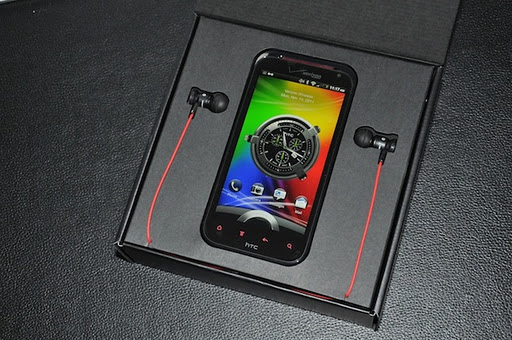
When you remove the outer sleeve and flip open the box, you’ll find the Rezound placed between the included Beats By Dre earbuds, one bud on either side. This part of the packaging is all black as well, which really makes the red wires of the headset pop out at you. It’s very clear that HTC believes that its Beats By Dre partnership is a huge deal, and in the consumer audio business, those red wires have become very, very iconic. If you’ve read some of my other reviews, you’ll know that I’m generally not a fan of headsets included with phones, but the addition Beats Audio may be an exception. More on that a little later.
Removing the top layer of the box’s interior reveals the remainder of the accessories: some documentation, a small pleather pouch for your Beats headset, some replacement earbuds of different sizes, and HTC’s usual USB wall charger and Micro USB cable. There’s also a 16GB microSD card included, which brings the phone’s total to 32GB between the internal and external storage — an appropriate amount considering the Rezound’s music promotion, oh, and the fact that Verizon’s charging $299 for it on contract.
At 13.7mm, the Rezound isn’t going to win any records for slim, sleek design. What’s interesting is that it launched just a few days after Motorola’s 7.1mm Droid RAZR, which is by far the thinnest LTE smartphone (and probably the thinnest smartphone) on the market. They’re both $299, and Verizon is positioning them both as very high-end devices, but their designs really couldn’t be much more different.
At first glance, you might think that the HTC Rezound is a very thick, or chunky device, but, it feels quite good in the hand. In fact, I prefer it to the Droid RAZR, which doesn’t really have any “hand-friendly” areas or surfaces. The Rezound’s 720p screen, is at 1280 x 720 compared to the RAZR’s 4.3 Super AMOLED qHD display. If you’re familiar with HTC’s Evo 3D, the Rezound’s look and feel are very similar, right down to the red accents. Around back you’ve got a textured, soft-touch material that should prevent all slips or drops.
Other features on back include the 8-megapixel camera with dual LED flash, the important Beats and 4G LTE logos, and a well-concealed loudspeaker grille. At maximum volume, the speakerphone was really loud for calls, music, and video playback.
The entire back lifts off to reveal a vibrant red interior. As with the more recent HTC devices, the cover doubles as an antenna, and if you took the cover off of the phone the Rezound immediately went to zero bars of reception as soon as I took it off. Obviously, you won’t be using the phone without a cover, but that raises the cost of getting a replacement and complicates the job of third-party accessory makers that want to offer an extended battery kit.
Finally, that takes us to the front of the Rezound. The bezel is fairly minimal on the left and right sides of the screen, with just a hint of black chrome peeking out from the very edge. The top has a long earpiece with a dark red grille, and I think it’s a nice touch. You can make out the front-facing camera on the upper right, but you won’t be able to see the proximity or light sensors at all. Below the display, the Rezound uses red backlighting for the four capacitive buttons; like the phone’s other red accents, I really like it, but I imagine some people might prefer the more traditional white.
All in all, I like the shape, size, and feel of this phone a lot more than I thought I would. It’s heavy, solid, and relatively thick, which makes it a complete opposite of the Droid RAZR’s insane design and engineering. I think some will find the phone too heavy or too thick, but hey — that’s exactly where the RAZR comes in (and now also, the Galaxy Nexus).
Display
I can talk about the Rezound’s LTE radio, 1.5GHz processor, and Beats Audio, but really, everyone’s eyes will be fixated on one feature alone: the 4.3-inch 720p LCD screen. It’s the first phone to launch with a high-definition display in the US, and a lot of people would want to see if the new display is better than the qHD screens on some of the more recent models from Motorola or HTC.
I can sum up all your questions about this display in one word: YES! You want this screen (or something very much like it) in your next smartphone. At a very high 342ppi, the Rezound shares the iPhone 4 and 4S’ unique ability to make individual pixels all but disappear to the naked eye, but, the Rezound does so at a higher resolution and a much larger screen size than the iPhone. Compared to the PenTile qHD displays in phones like the Droid Bionic and Droid RAZR, the Rezound runs circles around them, both for clarity and accuracy.
Outdoor viewability is very good, though I was able to get the screen to wash out in bright, direct sunlight (easily fixed by placing a hand over the screen). Looking at the Rezound full-on, I found contrast, brightness, and color temperature to be very near perfect. It’s very difficult to find fault with this display.
Beats Audio
I had to find out of the included earbuds are any good. I should point out that these are not the high-end Beats By Dre Tour model, but, they appear to be pitch-perfect copies of the company’s $100 iBeats. They fit in my ears very well, were comfortable to wear at length, and can be customized to fit your ears’ needs with the included pack of replacement buds.
The audio quality for earbuds is amazing! When you play music through the built-in Music app, a Beats logo appears in the status bar — this is your cue that the phone is running the Beats By Dre Mode, and it makes the output sound much “bigger and better.” All of my music sounded very good and, in all honesty, much better than I expected.
Cameras
I was really delighted with the Rezound’s camera interface, which is snappy, very pretty, and easy to use — it’s the same one that HTC employs on the Vivid and other recent devices, and it’s apparent that the company put some serious thought into how it should work. Autofocusing is fast, as is the shutter speed, and I found that I could really get up close with macro shots — about an inch and a half. I was once again disappointed here with the lack of a two-stage (halfway down for focus; full click for camera shot) hardware shutter button, but it seems like this is a feature that manufacturers are trying really hard to move away from for some reason.
I wasn’t blown away by the quality of either the 1080p video or the 8-megapixel photos when blown up to full size — there appears to be quite a bit of compression noise. It’s okay for messaging use and perhaps a wallpaper, but I wouldn’t replace either your point-and-shoot or your HD camcorder with the Rezound.
The front-facing camera is actually quite good, producing stills far cleaner and clearer than they realistically need to be for the intended duty (video calling, primarily). Like the Vivid, it’ll also let you record 720p video up front.
Wrap-up
The Rezound will likely go down as one of the best Android phones ever to launch pre-Ice Cream Sandwich — it’s incredible display, coming loaded with the LTE modem and beefy processor, is simply too great to ignore. If you’re looking for a phone with HTC Sense UI, blazing fast Verizon 4G LTE, and an amazingly fast processor, look no further than the HTC Rezound.




 Teague Loughman